
West Covina Directory Collections
The West Covina city directory shelf is regional rather than a single city-run database. Pacific Directory Co. editions explicitly name Baldwin Park, Covina, and West Covina. The Los Angeles County Library Californiana Collection holds nineteenth-century directories and California historical material. The West Covina Library supports local-history research with catalogs, databases, microfilm equipment, and newspaper access. The Historical Society has local histories, photographs, documents, Chamber booklets, and clipping files, but no public catalog or complete directory run was verified.
| Collection | Years | Where Held | Access |
|---|---|---|---|
| Baldwin Park, Covina and West Covina, California City Directory | 1950 | City study and regional research sources | Verify copy location before travel |
| Baldwin Park, Covina and West Covina, City Directory | 1955 | Regional and subscription-directory sources | Check local or digital availability |
| Covina-West Covina City Directory | Various dates | City bibliography and local repositories | Run is not fully published |
| Los Angeles extended-area telephone book | September 1935; regional runs 1935-1946 | Library of Congress and library collections | Free scan or repository inquiry |
| Federal census schedules | 1940 and 1950 | NARA and partner databases | 1950 West Covina EDs 19-701 to 19-706 |
Several gaps remain real. The research did not verify a complete annual run, a last printed year, a dedicated West Covina digital directory collection, or a separate city Sanborn edition. “Various dates” means ask a librarian or historian for the exact volume, not that every intervening year is present.
West Covina Library History Shelf
The West Covina Library at 1601 W. Covina Pkwy is the practical first stop for a local directory volume. Its documented services include a catalog, databases, research help, a microfilm reader, scanner and printer, the Los Angeles Times, and the San Gabriel Valley Tribune. Hours are Tuesday and Wednesday noon to 8, Thursday through Saturday 10 to 6, and closed Sunday and Monday. Ask staff to search the catalog for Pacific Directory Co., telephone books, local history, and newspaper microfilm before assuming a volume is absent.
The Los Angeles County Library Californiana Collection at Norwalk is closed-stack and holds more than 24,000 books and over 200 newspaper and magazine titles. Its described resources include California census material from 1850-1910, the Los Angeles Star from 1851-1879, nineteenth-century city directories, and city or county histories. A closed-stack collection may require a staff-mediated request rather than open browsing.
The West Covina Library location record is the best source for the local branch details.
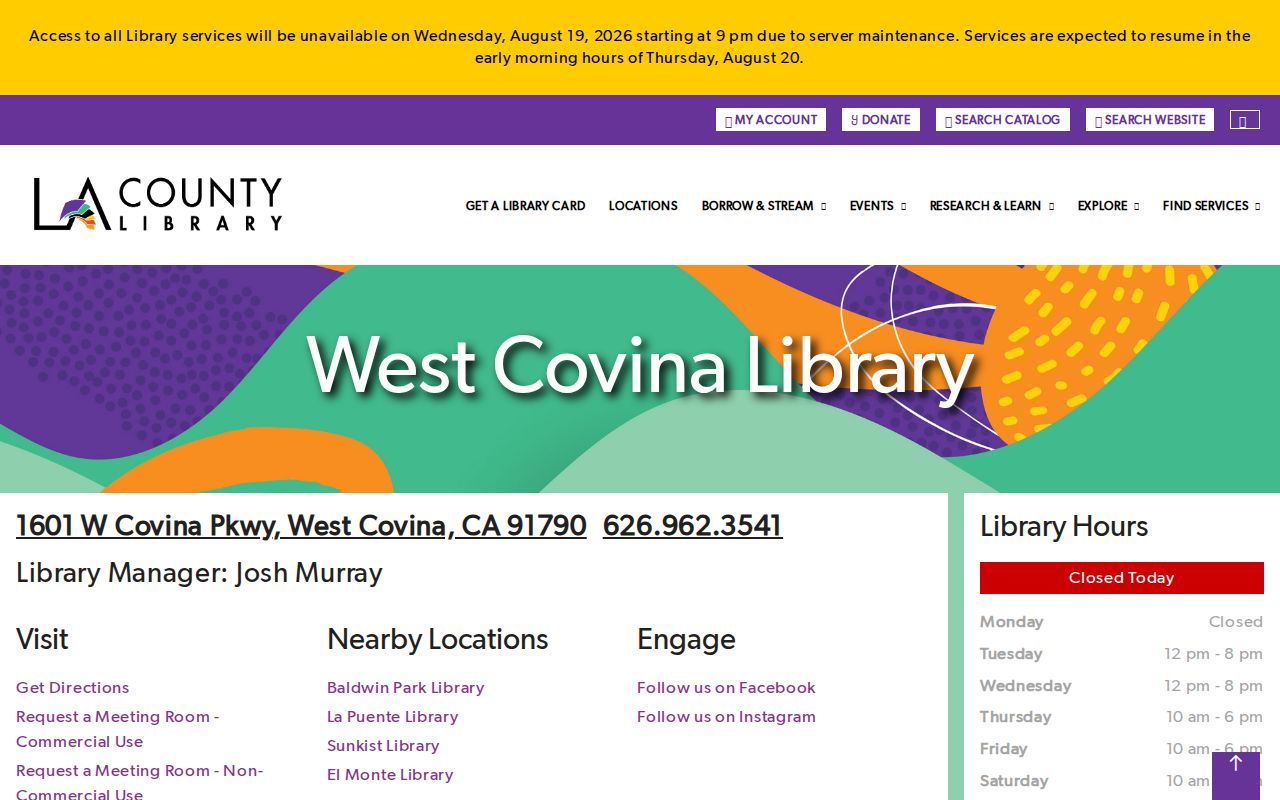
The library resource view shows why local directory research often succeeds through staff help and microfilm even when no public web index appears.
Regional West Covina Directory Evidence
West Covina entries can sit inside a title that also names Baldwin Park and Covina. Read the title page, publisher, locality list, and index before treating a regional volume as a complete West Covina collection. The postwar volume is especially useful because it sits inside the city's 1952-1956 growth surge. A directory entry may identify a person or business at a street address while the business, newspaper, or public affiliation sits in another San Gabriel Valley community.
The September 1935 Los Angeles extended-area telephone book provides a much earlier regional snapshot. A typical telephone entry uses a surname and given initials, may add a business or title, places “r” before a residence listing, and gives exchange and number. The Library of Congress catalog notes regional telephone runs through 1935-1946, but locality coverage should be checked reel by reel.
Regional genealogy guidance can help when a title is not obvious. The Los Angeles Public Library genealogy guide is a useful neighboring-repository route, not proof that every West Covina edition is digitized there.
A regional guide broadens the search vocabulary. Keep the West Covina locality and the exact publisher in the research notes.
Reading a West Covina City Directory
A West Covina city directory entry is best read as a set of fields, not a modern profile. The documented directory formats can include a name, residence, telephone, occupation or business, public affiliation, spouse, and sometimes alphabetical and reverse street sections. The 1935 telephone format uses initials and an exchange number. An actual personal entry from the subscription volumes was not available for inspection, so edition-specific spouse, owner, or occupant symbols should be confirmed from the volume's own key.
| Name | Listed person, surname first in many indexes, with initials or given name |
|---|---|
| Residence | Street address or a residence marker such as “r” in the telephone format |
| Telephone | Exchange and number when the household or business subscribed |
| Occupation or business | Public description attached to the entry, when supplied |
| Spouse or relationship | Possible field in generic directory formats; verify the edition |
| Owner or renter mark | Not established for the verified West Covina copies; do not assume a symbol |
- Criss-cross directory
- The reverse half arranged by street and address, useful after a name search.
- Householder index
- An index organized around the named head or household entry rather than every person present.
- Abbreviation key
- The volume's guide to short forms, symbols, exchanges, and address marks; photograph or transcribe it first.
When a street entry and a surname entry disagree, check the page year, index heading, spelling, and address. A listed subscriber may have moved before publication, and a household may have chosen not to list a telephone.
West Covina Directory Timeline
The known West Covina volume timeline has useful anchor points but no complete annual sequence. These dates are research handles. They do not imply that an edition exists for every year between them.
| 1935 | Los Angeles extended-area telephone book; a regional name, residence, and number snapshot |
|---|---|
| 1935-1946 | Known regional telephone runs in Library of Congress catalog records |
| 1940 | Federal census household schedule, with address and enumeration-district research |
| 1950 | Pacific Directory Co. volume and newest public federal census benchmark at the time of research |
| 1955 | Pacific Directory Co. Baldwin Park, Covina, and West Covina volume inside the postwar growth era |
| 1955-current | San Gabriel Valley Tribune title chain for notices, addresses, and community evidence |
West Covina's population rose from 4,499 in 1950 to 50,645 in 1960. That expansion makes tract maps and first permits essential companions when an address appears for the first time after 1950.
Trace West Covina Households Across Years
Use a West Covina city directory for a dated point, then fill the years around it with independent records. A 1955 surname can be compared with the 1950 schedule, a telephone run, a permit date, a newspaper notice, and a deed. The sequence distinguishes a move from a spelling change more reliably than a single missing entry.
- Start with the surname, initials, street address, and business or occupation field in the earliest useful directory.
- Search the same surname and nearby address in the next volume. Record every spelling, initial, household relationship, and street variant.
- Flip to the reverse or criss-cross section when the volume provides one. Note neighboring addresses without treating them as one household.
- Pair the directory year with the closest census. For 1950 West Covina, check enumeration districts 19-701 through 19-706 and browse the schedule when name search fails.
- Close a gap with a newspaper, obituary, probate file, first permit, or deed chain. Write “not found” when the evidence does not choose among move, death, omission, or address change.
Directory evidence and title evidence answer different questions. The deed identifies parties to land instruments. The assessment roll identifies assessed ownership. The listed volume identifies a person or subscriber at compilation time. A careful family-history trail keeps those roles separate.
When a current name needs modern verification after the historical trace, the West Covina resident lookup workflow supplies the court, vital, business, and license cross-checks.
West Covina's 1955 Directory Snapshot
The 1955 Pacific volume is more than a name list. Its entries identify firms and addresses such as Conditionaire Ltd. at 1211 N Azusa Canyon Road, Union Oil at 1122, Precision Steel Equipment at 1117, W.R. Munsen at 1125, and Skyline Skating Rink at 1133. Those examples show how the volume can reconstruct the address-to-business landscape around a household even when a personal entry is not available.
Read the commercial entries as place evidence, then compare them with the city context and the date of local construction. West Covina's postwar tract growth, road changes, and municipal expansion mean that a current address may have been orchard land, a farm lease, or another community description in an older source. A directory gap can be a development clue rather than a failed search.
Note: A directory presence proves a listed entry at publication time; it does not prove every household member, title ownership, or continuous residence.
West Covina Newspapers After a Directory Gap
The local newspaper chain can bridge years that no volume covers. Titles include the San Gabriel Valley Daily Tribune from 1955-1980, Tribune from 1980-1982, the San Gabriel Valley Daily Tribune again from 1982-1991, and the San Gabriel Valley Tribune from 1991-current. Predecessor weeklies included the West Covina Tribune, Baldwin Park Bulletin, and Covina Argus Citizen.
Obituaries can supply a former address, survivors, a move, or a community tie. Library microfilm and the California Newspaper Microfilm Archive may hold title runs, but a catalog holding is not the same as an online issue image. Ask the West Covina Library or the archive for the specific date. Probate records belong to Los Angeles Superior Court, not RR/CC.
Use the Los Angeles County Library database and Californiana information as a repository lead, then verify any newspaper statement in the issue or court file.
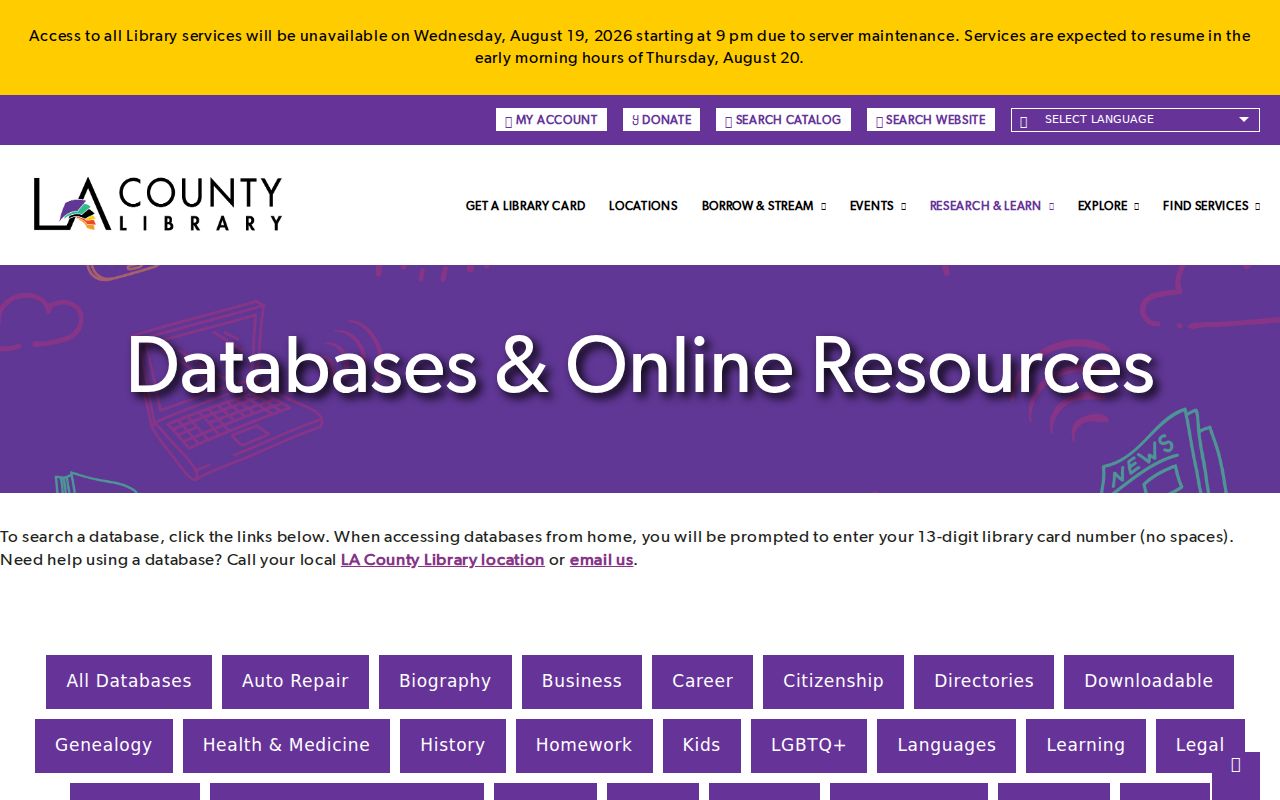
Repository databases expand the search beyond a single volume, while the original date and page keep the result anchored.
West Covina Community History Companions
Local history can preserve names that never appear in a volume. The Historical Society of West Covina holds histories, photographs, documents, Chamber booklets, and clipping files, including a “Business and Commercial 1960-1980” bin. The East San Gabriel Valley Japanese Community Center at 1203 W. Puente Ave. grew from a 1936 land gift and preserves newsletters, annual reports, press materials, and Keepers of the Flame oral histories. These collections may document community ties and officers without providing a public membership roster.
West Covina Library research can be paired with school yearbook inquiries through WCUSD, local Chamber material, and newspapers. Exact legacy yearbook runs, cemetery lists, church registers, and a complete FamilySearch city list were not verified. Ask the holding institution about a surname, street, tract, year, or permission to view material rather than assuming coverage.
The East San Gabriel Valley Japanese Community Center is a documented local-history resource, while the WCUSD school list is a contact route for school-history questions.
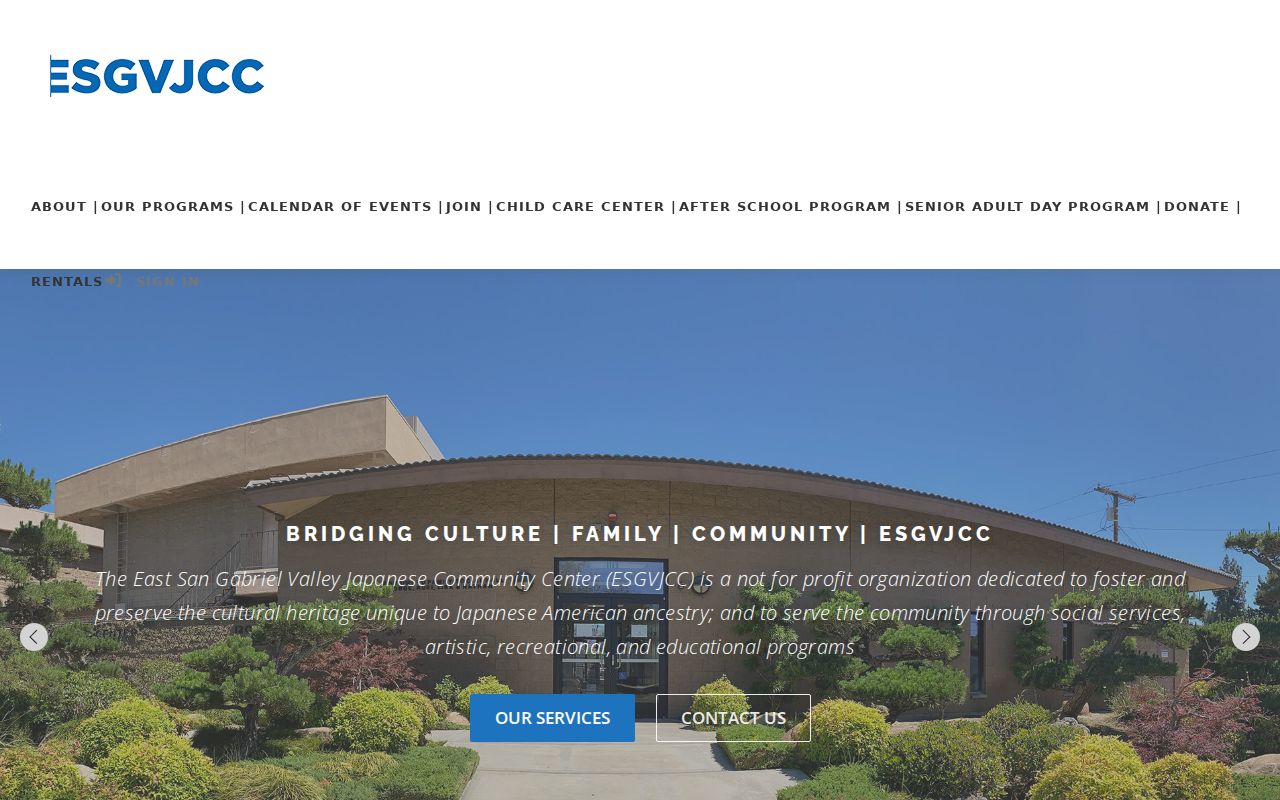
Community history adds human context to a West Covina volume, but each oral history or booklet still needs its date, creator, and scope recorded.
West Covina Directory Research Help
Friends and support organizations can point researchers toward local-history programs without replacing the library or archive that holds the item. A repository request should name the exact volume, publisher, locality, and year. Ask whether photography, scanning, microfilm printing, or staff-assisted searches are allowed. Keep a note of a negative search, because a missing 1957 volume is different from an unsearched catalog.
The Friends of the West Covina Library capture in the research manifest is a local library-support lead. It does not establish a collection by itself. The verified collection facts remain the 1950 and 1955 Pacific volumes, the 1935-1946 telephone material, the census schedules, and the regional newspaper chain.
A local library-support resource can help with discovery, while the final citation should name the library, collection, volume, page, and date actually consulted.